Push Ups For The ADF/Police
Although push ups are no longer a requirement for Navy & Air Force pre-entry fitness assessments (see know your fitness standards), they are still something that EVERYONE should be working on.
Being able to perform a good amount of push ups indicates a good amount of upper body strength and muscular endurance which is critical to have as a tactical athlete.
Navy and Air Force no longer require you to be able to perform a push up before you enlist but this does not mean you are not required to do them once you are enlisted.
If you are able to create a solid baseline of upper body strength and muscular endurance which is displayed by the amount of push ups you can perform then you will not only be able to pass your fitness tests at basic training but you will find that this additional upper body strength will help with a multitude of tasks including obstacle courses, hand-hand combat, fire and movement, body drags and even holding a rifle at your shoulder.
Below is an in-depth video about how to conduct a technically efficient push up to the standards of the Australian Defence Force
Training For Push Ups
It's very clear that a lot of people just don't have the knowledge about what needs to be trained to improve push ups. So here's some basic info to help steer you in the right direction. Once you can do 60+ reps in a row than the approach/methods start to change.
Exercise Selection
To improve your push up strength you need to improve your upper body strength specific to the "push" movement pattern which is essentially any movement that involves you pushing something away from your body using your upper body. A strong back and core are also very important elements to help with this movement indirectly.
When creating your workout choose 1-2 compound main lifts that train the push pattern.
Example exercises:
▪️Push Up Variations
▪️Bench Press Variations
▪️Dip Variations
▪️Shoulder Press Variations
Frequency
The best place to start is to include 2-3 push up focused strength workouts per week.
Volume/Intensity
The reason you cannot do a push up/struggle with them right now is because you lack the STRENGTH not endurance. So to build strength you MUST lift heavy things to stimulate the nervous system and muscles correctly. Strength work in circuit form like F45 and CrossFit metcons etc WILL NOT build your strength.
Instead use simple sets and reps that you build the weight each time you repeat the workout. Start by performing 3-5 sets of 5 reps each set with a 2-3 minute (yes a 2-3min!) rest between sets. You can do other things during your rest that won't interfere such as exercises for you back, legs or even light cardio.
You don't need to go to failure each set but you need to push the limits so that you are only leaving 1-2 reps left in the tank each set. The long rests should allow you to use the same weight across all sets.
Accessory Work
After your main lifts choose a couple of exercises working the same muscles and perform some higher rep sets. Don't go crazy if you a hitting 3 sessions per week.
Example exercises:
▪️Regressed Push Up Variations
▪️Lighter weights on push pattern variations
▪️Pec Fly Variations
▪️Tricep Extension Variations
▪️Front Delt Raises
Progression
Repeat the workouts for 4-6 weeks with the focus to build the weight and BE AWARE this will not "feel" like you do after you complete an endurance circuit like F45. You will not feel completely exhausted because it is not training your energy systems, it is training your STRENGTH which feels a lot different.
If you consistently target and progress the correct movement pattern with proper strength training and include extra upper back and core training I can 100% guarantee you will improve quickly.
🚀 Bonus
If you're just starting out and struggling to do a single push-up on the ground, this recorded workshop video is exactly what you need. It’s designed to help you achieve your first push-up, with no equipment required, and you can do it anywhere. Check it out below.
Pre-entry Fitness Targets
Over my 16 year career in the full-time Army I never even knew what the pass mark was for my age and gender. This was because I knew I could pass and the only thing I was focused on was how many I could do!
This is the attitude I want all of you to take on. Always strive to be better!
My official highest push up score was 105 reps in 2 minutes (below is a video of 91) but I have seen many people do a lot more.
You don't have to be the best as long as you continue to improve and don't settle for good enough. Continue to push your limits and find out what you are capable of.
Here are some suggested targets that will have you sitting in a better position than 90% of other recruits and will set you up for success for active service fitness testing.
🎯 2min Push up Test (Army)
Males = 50+
Females = 30+
🎯 Cadence Push Up Test (Navy/Air Force/SF)
Males = 35+
Females = 20+
Special Forces = 60+
7 Day Beginner Push Up Program
To help you get started I would like to gift you a 7 day beginner push up program that you can download for free. These workouts can be repeated for 4-6 weeks with the goal to progress the workouts as much as possible.
Learn more about push up training here:
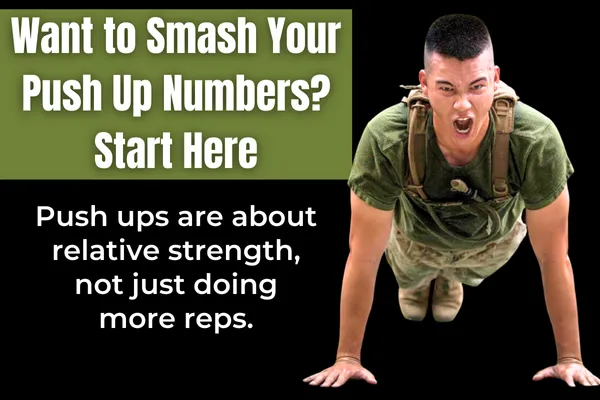
Push-Up Progress Isn’t About Reps — It’s About Strength
Push-Up Progress Isn’t About Reps — It’s About Strength
If you're preparing for enlistment or basic training, chances are you've been told to “just do more push-ups.”
But if that’s all it took, you’d already be smashing out high numbers.
The reality? Push-up performance has less to do with endurance and far more to do with something called relative strength.
Whether you’re training for your PFA or aiming to stand out at basic training, understanding this one concept will change how you train — and help you see real, lasting progress.
Why Relative Strength Matters
Relative strength is your ability to produce force relative to your bodyweight.
Push-ups are a bodyweight movement — meaning every extra kilo you carry makes the exercise harder. Unlike lifting a fixed weight, you are the weight.
This means two things are critical:
Body composition: Carrying unnecessary body fat? You're working harder with every rep.
Strength in the right movement pattern: You need to be strong in a horizontal pushing pattern — the exact motion used in a push-up.
If one of these is off, your progress will stall. If both are off, you’ll stay stuck.
Why Just Doing More Push-Ups Doesn’t Work
Endless volume might seem like a good idea — but if you're not strong enough to move your own body through the full range of motion, you're only reinforcing poor form and wearing yourself down.
Push-ups require strength first, not just repetition.
You need the ability to generate enough force to lift your body from the bottom of the movement — especially under fatigue. That only comes from structured strength training.
The Role of Pressing Strength (and Why the Bench Press Works)
To develop the strength needed for push-ups, you need to strengthen the muscles that drive the movement:
Chest (pecs)
Shoulders (delts)
Triceps
One of the best tools to do this is the barbell bench press. Here’s why it’s so effective:
Movement match: It trains the same horizontal pushing pattern
Progressive overload: You can steadily increase resistance
Safe setup: Easier to control compared to dumbbells, especially for beginners
The stronger your bench relative to your bodyweight, the easier each push-up becomes. You use less energy per rep, fatigue slower, and perform more reps with better form.
What’s “Strong Enough” for Push-Ups?
Here’s a reliable benchmark to assess your readiness:
✅ 1 rep at 75% of your bodyweight on the bench press
✅ Or ~5 reps at 65–70%
These numbers indicate you’ve built the minimum strength needed to push yourself back up from full depth consistently.
Once you exceed this level, each push-up becomes a smaller percentage of your max strength — meaning you’ll experience less muscular fatigue per rep, and your total rep count goes up.
Two Strength Programs to Build Your Push-Up Base
You don’t need fancy equipment or complicated routines. What you need is structured, consistent strength training that targets your pressing muscles and allows for steady progression.
Here are two proven systems:
Option 1: Linear Strength Progression
This is ideal for beginners or anyone returning to training.
Cycle 1
3 sets of 5 reps
1-2 times per week
Start your first session using a weight you could bench for 10 reps (~65% 1RM). This allows progression each session rather than starting at, or close to your max.
Use the same weight across all sets
Add 2.5–5kg each session
Cycle 2
5 sets of 3 reps
1-2 times per week
Add 1.25–2.5kg each session
Progress to this once you begin failing reps in Cycle 1
Simple. Effective. And brutally consistent.
Option 2: Wendler 5/3/1 Method
This system is ideal for intermediate lifters or those who want a longer-term progression.
Start with 90% of your 1RM as your “training max” (TM):
Week 1: 3 sets of 5 reps @ 65/75/85% of your TM.
Week 2: 3 sets of 3 reps @ 70/80/90%
Week 3: 5/3/1 reps @ 75/85/95%
Week 4: Deload week (3x5 @ 60%)
At the end of the month, add 2.5kg to your training max and repeat the cycle.
Top sets each week should be performed as AMRAPs (as many reps as possible) to help push adaptation while staying within the structure.
E.g. For your 3rd set in week 1 at 85%, you should aim to do as many reps as possible even if it's well above the prescribed 5 reps.
Focus on the Right Metrics
If you’re serious about improving push-ups for the PFA or surviving the early weeks at Kapooka, shift your focus:
Train your pressing strength
Reduce excess weight that’s slowing you down
Use benchmarks to assess your readiness — not guesswork
Push-up capacity is a byproduct of smart strength work, not just high-rep punishment.
Train Like It Matters
Improving push-ups isn’t just about passing a test — it’s about building the kind of strength and endurance that will serve you in training, in the field, and on the job.
If you want a complete training system that builds the exact type of fitness the ADF is looking for — strength, muscular endurance, and resilience — check out the Fit For Service Training Plan.
It’s designed specifically for applicants and recruits preparing for service. No BS. Just results.
And if you’re after even more detailed breakdowns and support, this Push-Up Training Guide is a great place to dive deeper.
Next up: If you want the full picture of what to expect, read Surviving the PFA at Kapooka — a must-read for anyone heading to basic.


© OUTPERFORM FITNESS All Rights Reserved 2020