Push Ups For The ADF/Police
Although push ups are no longer a requirement for Navy & Air Force pre-entry fitness assessments (see know your fitness standards), they are still something that EVERYONE should be working on.
Being able to perform a good amount of push ups indicates a good amount of upper body strength and muscular endurance which is critical to have as a tactical athlete.
Navy and Air Force no longer require you to be able to perform a push up before you enlist but this does not mean you are not required to do them once you are enlisted.
If you are able to create a solid baseline of upper body strength and muscular endurance which is displayed by the amount of push ups you can perform then you will not only be able to pass your fitness tests at basic training but you will find that this additional upper body strength will help with a multitude of tasks including obstacle courses, hand-hand combat, fire and movement, body drags and even holding a rifle at your shoulder.
Below is an in-depth video about how to conduct a technically efficient push up to the standards of the Australian Defence Force
Training For Push Ups
It's very clear that a lot of people just don't have the knowledge about what needs to be trained to improve push ups. So here's some basic info to help steer you in the right direction. Once you can do 60+ reps in a row than the approach/methods start to change.
Exercise Selection
To improve your push up strength you need to improve your upper body strength specific to the "push" movement pattern which is essentially any movement that involves you pushing something away from your body using your upper body. A strong back and core are also very important elements to help with this movement indirectly.
When creating your workout choose 1-2 compound main lifts that train the push pattern.
Example exercises:
▪️Push Up Variations
▪️Bench Press Variations
▪️Dip Variations
▪️Shoulder Press Variations
Frequency
The best place to start is to include 2-3 push up focused strength workouts per week.
Volume/Intensity
The reason you cannot do a push up/struggle with them right now is because you lack the STRENGTH not endurance. So to build strength you MUST lift heavy things to stimulate the nervous system and muscles correctly. Strength work in circuit form like F45 and CrossFit metcons etc WILL NOT build your strength.
Instead use simple sets and reps that you build the weight each time you repeat the workout. Start by performing 3-5 sets of 5 reps each set with a 2-3 minute (yes a 2-3min!) rest between sets. You can do other things during your rest that won't interfere such as exercises for you back, legs or even light cardio.
You don't need to go to failure each set but you need to push the limits so that you are only leaving 1-2 reps left in the tank each set. The long rests should allow you to use the same weight across all sets.
Accessory Work
After your main lifts choose a couple of exercises working the same muscles and perform some higher rep sets. Don't go crazy if you a hitting 3 sessions per week.
Example exercises:
▪️Regressed Push Up Variations
▪️Lighter weights on push pattern variations
▪️Pec Fly Variations
▪️Tricep Extension Variations
▪️Front Delt Raises
Progression
Repeat the workouts for 4-6 weeks with the focus to build the weight and BE AWARE this will not "feel" like you do after you complete an endurance circuit like F45. You will not feel completely exhausted because it is not training your energy systems, it is training your STRENGTH which feels a lot different.
If you consistently target and progress the correct movement pattern with proper strength training and include extra upper back and core training I can 100% guarantee you will improve quickly.
🚀 Bonus
If you're just starting out and struggling to do a single push-up on the ground, this recorded workshop video is exactly what you need. It’s designed to help you achieve your first push-up, with no equipment required, and you can do it anywhere. Check it out below.
Pre-entry Fitness Targets
Over my 16 year career in the full-time Army I never even knew what the pass mark was for my age and gender. This was because I knew I could pass and the only thing I was focused on was how many I could do!
This is the attitude I want all of you to take on. Always strive to be better!
My official highest push up score was 105 reps in 2 minutes (below is a video of 91) but I have seen many people do a lot more.
You don't have to be the best as long as you continue to improve and don't settle for good enough. Continue to push your limits and find out what you are capable of.
Here are some suggested targets that will have you sitting in a better position than 90% of other recruits and will set you up for success for active service fitness testing.
🎯 2min Push up Test (Army)
Males = 50+
Females = 30+
🎯 Cadence Push Up Test (Navy/Air Force/SF)
Males = 35+
Females = 20+
Special Forces = 60+
7 Day Beginner Push Up Program
To help you get started I would like to gift you a 7 day beginner push up program that you can download for free. These workouts can be repeated for 4-6 weeks with the goal to progress the workouts as much as possible.
Learn more about push up training here:
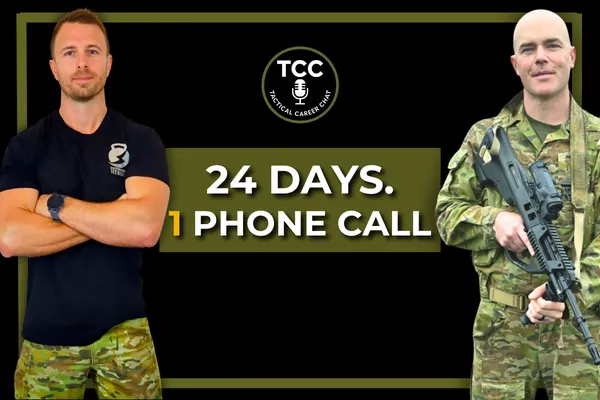
Army Reserve Kapooka Experience | ADF Recruit Training
Army Reserve Kapooka Experience: What to Expect From Application to Recruit Training
If you’re applying to join the Army Reserve, one thing you’ll quickly learn is that the process doesn’t always run to the timeline you expect.
In this Tactical Career Chat, I spoke with Tim, who recently joined the Army Reserve as a Light Cavalry Scout in Armoured Corps.
His journey took almost two years from applying through to finally getting to Kapooka. Along the way he dealt with medical delays, changing recruitment timelines, trying to stay motivated with his training, and balancing all of that around long workdays and a young family.
And even after spending that long preparing, he still described those first few days at Kapooka as pretty confronting.
There are some good lessons in his experience for anyone currently going through the ADF application process, especially if your own timeline is starting to drag out.
This article is based on Tim’s personal experience and is not presented on behalf of the Australian Defence Force.
Why He Chose the Army Reserve
Joining the Army wasn’t a new idea for Tim.
He’d considered it a few times throughout his life and came from a family with a strong military background. His dad had served in the Navy for 20 years, and when Tim was younger he had originally looked at becoming an officer.
Life went in another direction and he built a civilian career, but the idea of serving never really disappeared.
A big turning point came when his brother made a major career change and joined the fire service. It got Tim thinking about what he wanted to look back on later in life.
He enjoyed his job and had worked hard to build his career, so he didn’t necessarily want to walk away from all of that. The Army Reserve gave him a way to serve while still keeping his civilian career and being there for his family.
He also knew he wanted a combat role rather than a support role and eventually chose Armoured Corps after considering both Armoured and Infantry. Part of the appeal was having something that would keep pushing him to stay fit and healthy as he got older.
The ADF Application Process Took Almost Two Years
This is where his journey really started to drag out.
Tim applied in 2024 and tried to get everything organised early. He submitted his paperwork and eventually completed his Defence and psychology interviews a few months later.
Then the medical side slowed everything down.
Because of previous medical history, additional reports were required. Tim followed up after his medical appointment and believed everything had been received.
Around six months later, he received communication saying his application could be withdrawn if he didn’t provide reports that were still outstanding.
After chasing it up again, he found out more information was required.
That ended up costing him roughly another six or seven months.
This is where I’d be pretty proactive if you’re currently applying.
If you’re waiting on medical documents, reports or another part of the process and you’re not sure where things are up to, follow it up.
Don’t just assume everything is moving in the background because you haven’t heard anything.
Tim was already following things up and still ended up with a long delay.
Then around May 2025 he was told there was a role available and he could potentially be heading to Kapooka in June or July.
After waiting that long, it finally looked like things were moving.
Then communication stopped.
By the time he spoke with another recruiter, the positions had been filled. He was told he could either potentially wait another 12 months for Armoured Cavalry or move across to Infantry, which had been his second preference.
He decided to wait for the role he actually wanted.
Staying Fit When You Don’t Know Your Enlistment Date
This is where a lot of applicants come unstuck.
It’s pretty easy to stay motivated when you’ve got a fitness test in six weeks or you know you’re heading to Kapooka on a certain date.
It’s much harder when you’ve been told you might be waiting another year.
Tim admitted his training dropped off for a month or two after that setback.
Eventually he realised a position could still come up at any time, so he got back into training and kept preparing.
I talk about this all the time with applicants.
You can’t be ready too early.
If your application gets delayed, that doesn’t mean your training needs to stop until you get another date.
Use the extra time.
Build more fitness, get stronger, improve your running and give yourself a bigger buffer before recruit training.
You don’t want to spend months waiting, finally get an opportunity and then realise you let your fitness disappear while you were sitting around waiting for recruiting.
Making Training Fit Around Work and Family
Tim also had to work out how to prepare around a normal life.
He had young kids at home and could be doing 10 to 12-hour workdays plus travel. Some days stretched out even longer.
Training after work wasn’t ideal because he wanted to get home and spend time with his family, so he moved most of his training to the morning.
That often meant getting up around 4am, training, showering and then getting to work for a 7am start.
At the start he was trying to hit five or six sessions each week.
Eventually he realised that wasn’t sustainable.
He backed it down to around four priority sessions. Some weeks he got them all done. Some weeks he didn’t. Occasionally he got an extra session in.
That’s a much better way of looking at training than building a perfect seven-day plan that falls apart as soon as work gets busy.
Your training needs to fit your actual life.
If you can consistently hit four good sessions for the next six months, that’s going to get you a lot further than trying to force six sessions for three weeks and then dropping off completely.
Recovery matters as well.
Tim said one of his biggest struggles was trying to balance his training with sleep, long workdays, overtime and family time.
There will be weeks where pushing harder isn’t the right answer.
Sometimes you need to adjust the week, protect your sleep and keep enough training in to continue moving forward.
From Enlistment to Kapooka
After almost two years of waiting, Tim eventually enlisted.
His wife and kids came along to the enlistment ceremony and, after spending so long trying to get there, that was the point where it finally started to feel real.
After enlistment, he started working with what he described as the Future Workforce Cell, which had previously been referred to as the RIC.
He completed initial training activities, pre-Kapooka modules and practice PFAs before eventually heading to Kapooka.
By then, the fitness side wasn’t something he was particularly worried about.
He’d had nearly two years to prepare.
That turned out to be one of the advantages of such a long application process.
What the First Few Days at Kapooka Were Like
Once he finally got there, things changed pretty quickly.
The bus ride into Kapooka initially felt fairly relaxed.
Then they arrived at the barracks.
The tone changed, the instructions started coming in and suddenly it felt real.
Tim had watched Tactical Career Chats and had a fair idea of what was coming, but he still said being there and actually doing it was confronting.
It took him around three or four days to start settling in.
During his first phone call home, he thought he sounded fine. His wife could immediately tell he was stressed.
He described those first few days as his body basically going into survival mode while he tried to absorb everything being thrown at him.
Instructions, drill, timings, names, routines and trying not to forget something five seconds after being told.
He said it took a few days before he wasn’t constantly feeling like his heart rate was through the roof.
That’s why I think it’s worth preparing the things you can control before you go.
You’re not going to recreate Kapooka at home.
But you can turn up fit.
You can learn some basic information beforehand.
You can get used to following a routine.
And you can avoid turning up with your fitness already being something you’re stressed about.
One Simple Thing He Prepared Before Kapooka
A good example was the phonetic alphabet.
Tim had practised it before heading down.
During the course, an instructor tested some of the recruits by getting them to say their surnames using the phonetic alphabet.
Tim already knew it.
That meant it was one less thing he had to learn while he was tired, under pressure and already trying to remember everything else.
That’s the way I’d look at your preparation.
You don’t need to try to teach yourself how to be a soldier before you arrive.
That’s what the training is for.
But if there are simple things you can prepare beforehand, there’s no reason to make life harder for yourself by leaving everything until you get there.
Teamwork, Retraining and Holding Your Own
Another big part of Tim’s experience was learning how quickly one person’s actions can affect everyone else.
His platoon was retrained regularly, including fairly late into the course.
That could be frustrating when the same small mistakes kept happening.
But that’s also part of learning how to operate as a team.
You need to help the people around you.
At the same time, you need to hold your own.
Be switched on. Be physically capable. Pay attention. Take responsibility for your own stuff.
You don’t want to be the person everyone constantly has to bring up to standard.
That doesn’t mean you’ll never make a mistake.
Everyone will.
But there’s a big difference between occasionally making a mistake and turning up completely unprepared.
The Hardest Part Wasn’t Fitness
For Tim, one of the biggest struggles at Kapooka was actually being away from his family.
He said he only got access to his phone three times.
On two of those occasions his kids were already asleep.
Across 24 days, he only got to speak to them properly once and relied on audio messages the other times.
That’s another side of recruit training applicants sometimes don’t think about.
Everyone worries about the fitness.
But depending on where you are in life, being away from your partner, kids and normal routine can be just as challenging.
What ADF Applicants Can Take From His Experience
There are a few things I’d take from Tim’s journey if you’re currently preparing to join.
Get your application started early.
His process took almost two years. Your timeline might be different, but there’s not much benefit in sitting around for another six months thinking about applying.
Follow up your application.
Especially if you’re waiting on paperwork, medical reports or something that doesn’t seem to be moving.
Don’t let delays become an excuse to stop training.
You might not control your enlistment date, but you do control what you do while you’re waiting.
Build a training week you can actually maintain.
Tim found four priority sessions worked better than trying to force five or six every week.
Get fit before the timeline becomes urgent.
You don’t want to finally get your date and then start trying to cram months of training into a few weeks.
Prepare the simple things you can.
Knowing the phonetic alphabet helped because it was one less thing he needed to learn under pressure.
Expect Kapooka to feel different once you’re actually there.
You can watch as many videos as you like, but you still need to adapt once the training starts.
Most importantly, turn up prepared enough that fitness isn’t another thing taking up your attention.
By the end of the interview, that was one of Tim’s biggest points.
After training for two years, he didn’t have to worry about whether he was physically capable of getting through the fitness side of things.
There was already enough other stuff going on.
Frequently Asked Questions
How long does the ADF application process take?
There isn’t one timeline that applies to everyone.
In Tim’s case, his journey took almost two years and included delays around medical reports and waiting for a vacancy in his preferred role.
The main lesson is not to assume your own application will move according to a fixed timeline.
What are the first few days at Kapooka like?
Tim described his first three to four days as highly stressful and confronting.
He was trying to absorb large amounts of information, learn drill and routines and adjust to being under pressure.
After a few days, he started to settle into the environment.
How fit should I be before going to Kapooka?
Tim didn’t give a specific fitness standard in the interview.
What he did say was that after training for around two years, fitness wasn’t something he was worried about when he got there.
His advice was to start working on your fitness early rather than waiting until your date is getting close.
What happens after Army Reserve enlistment before Kapooka?
In Tim’s experience, he completed initial activities through the Future Workforce Cell, including pre-Kapooka modules and practice PFAs before attending Kapooka.
Your own pathway may differ, so follow the instructions you’re given during your application and enlistment.
How often can you contact family at Kapooka?
In Tim’s experience, he got access to his phone three times during the course.
Because of the timing, he only managed one proper conversation with his kids across the 24 days and used audio messages on the other occasions.
That was his individual experience and shouldn’t be taken as a guaranteed phone schedule for every course.
Start Preparing Before You Need to Be Ready
You don’t control how quickly recruiting moves.
You do control how prepared you are when the opportunity finally comes.
If your application gets delayed, keep training.
If you haven’t applied yet, don’t wait until your fitness is perfect before starting the process.
And if you know joining the ADF is something you want to do, start building your fitness now instead of waiting until someone gives you a date.
Fit For Service Training Plan
If you’re preparing to join the ADF and want some help getting your training structured properly, that’s exactly what we do with our Fit For Service Training Plan.
It’s built specifically for ADF applicants preparing for enlistment, recruit training and the demands of service.


© OUTPERFORM FITNESS All Rights Reserved 2020