Push Ups For The ADF/Police
Although push ups are no longer a requirement for Navy & Air Force pre-entry fitness assessments (see know your fitness standards), they are still something that EVERYONE should be working on.
Being able to perform a good amount of push ups indicates a good amount of upper body strength and muscular endurance which is critical to have as a tactical athlete.
Navy and Air Force no longer require you to be able to perform a push up before you enlist but this does not mean you are not required to do them once you are enlisted.
If you are able to create a solid baseline of upper body strength and muscular endurance which is displayed by the amount of push ups you can perform then you will not only be able to pass your fitness tests at basic training but you will find that this additional upper body strength will help with a multitude of tasks including obstacle courses, hand-hand combat, fire and movement, body drags and even holding a rifle at your shoulder.
Below is an in-depth video about how to conduct a technically efficient push up to the standards of the Australian Defence Force
Training For Push Ups
It's very clear that a lot of people just don't have the knowledge about what needs to be trained to improve push ups. So here's some basic info to help steer you in the right direction. Once you can do 60+ reps in a row than the approach/methods start to change.
Exercise Selection
To improve your push up strength you need to improve your upper body strength specific to the "push" movement pattern which is essentially any movement that involves you pushing something away from your body using your upper body. A strong back and core are also very important elements to help with this movement indirectly.
When creating your workout choose 1-2 compound main lifts that train the push pattern.
Example exercises:
▪️Push Up Variations
▪️Bench Press Variations
▪️Dip Variations
▪️Shoulder Press Variations
Frequency
The best place to start is to include 2-3 push up focused strength workouts per week.
Volume/Intensity
The reason you cannot do a push up/struggle with them right now is because you lack the STRENGTH not endurance. So to build strength you MUST lift heavy things to stimulate the nervous system and muscles correctly. Strength work in circuit form like F45 and CrossFit metcons etc WILL NOT build your strength.
Instead use simple sets and reps that you build the weight each time you repeat the workout. Start by performing 3-5 sets of 5 reps each set with a 2-3 minute (yes a 2-3min!) rest between sets. You can do other things during your rest that won't interfere such as exercises for you back, legs or even light cardio.
You don't need to go to failure each set but you need to push the limits so that you are only leaving 1-2 reps left in the tank each set. The long rests should allow you to use the same weight across all sets.
Accessory Work
After your main lifts choose a couple of exercises working the same muscles and perform some higher rep sets. Don't go crazy if you a hitting 3 sessions per week.
Example exercises:
▪️Regressed Push Up Variations
▪️Lighter weights on push pattern variations
▪️Pec Fly Variations
▪️Tricep Extension Variations
▪️Front Delt Raises
Progression
Repeat the workouts for 4-6 weeks with the focus to build the weight and BE AWARE this will not "feel" like you do after you complete an endurance circuit like F45. You will not feel completely exhausted because it is not training your energy systems, it is training your STRENGTH which feels a lot different.
If you consistently target and progress the correct movement pattern with proper strength training and include extra upper back and core training I can 100% guarantee you will improve quickly.
🚀 Bonus
If you're just starting out and struggling to do a single push-up on the ground, this recorded workshop video is exactly what you need. It’s designed to help you achieve your first push-up, with no equipment required, and you can do it anywhere. Check it out below.
Pre-entry Fitness Targets
Over my 16 year career in the full-time Army I never even knew what the pass mark was for my age and gender. This was because I knew I could pass and the only thing I was focused on was how many I could do!
This is the attitude I want all of you to take on. Always strive to be better!
My official highest push up score was 105 reps in 2 minutes (below is a video of 91) but I have seen many people do a lot more.
You don't have to be the best as long as you continue to improve and don't settle for good enough. Continue to push your limits and find out what you are capable of.
Here are some suggested targets that will have you sitting in a better position than 90% of other recruits and will set you up for success for active service fitness testing.
🎯 2min Push up Test (Army)
Males = 50+
Females = 30+
🎯 Cadence Push Up Test (Navy/Air Force/SF)
Males = 35+
Females = 20+
Special Forces = 60+
7 Day Beginner Push Up Program
To help you get started I would like to gift you a 7 day beginner push up program that you can download for free. These workouts can be repeated for 4-6 weeks with the goal to progress the workouts as much as possible.
Learn more about push up training here:
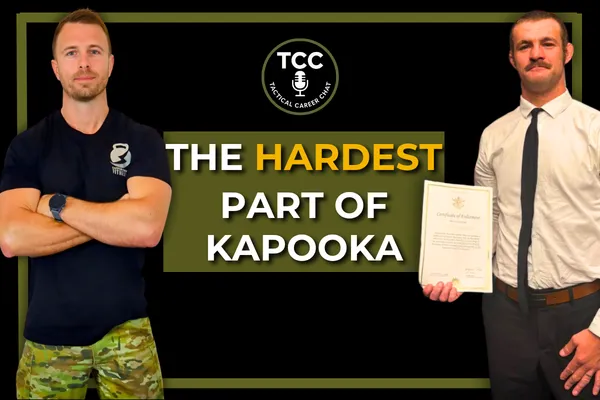
How to Prepare for Kapooka: Lessons from a New Army Reserve Recruit
How to Prepare for Kapooka: Lessons from a New Army Reserve Recruit
Every person who joins the Australian Defence Force has a different story.
Some know from childhood that's what they want to do. Others discover it later in life after wanting a new challenge.
Cam's journey was somewhere in the middle.
After years working as a painter, competing in martial arts and raising a young family, he finally decided it was time to pursue something he'd wanted since he was a kid. That decision eventually led him to joining the Australian Army Reserve as an Infantry Soldier.
Recently, I sat down with Cam after he'd completed Kapooka to talk through the entire journey. From applying and waiting through medical delays, right through to arriving at recruit training and the lessons he wishes every future recruit knew beforehand.
If you're preparing to join the Army, or even just considering it, there's plenty you can learn from his experience.
A Goal That Never Really Went Away
Like many applicants, joining the Army wasn't a spur of the moment decision.
Cam had wanted to join since he was young but put the idea aside as life moved on. He built a career as a painter, started a family and spent years competing in martial arts.
Eventually he reached a point where he wanted a fresh challenge.
Infantry appealed because it represented exactly what he was looking for. A physically demanding role that would push him outside his comfort zone.
Instead of joining full-time, he chose the Army Reserve so he could continue supporting his family while still pursuing military service.
It's a reminder that there isn't one "perfect" time to join. Everyone arrives there differently.
The Recruitment Process Didn't Go to Plan
Cam first applied in December 2024.
Like many ADF applicants, things didn't move as quickly as he'd hoped.
Medical requirements meant he had to wait, complete additional steps and eventually reapply before finally enlisting in March 2026.
He admitted it was frustrating.
Waiting is often one of the hardest parts of the recruitment process because it feels like nothing is happening.
Instead of letting that stop him, he shifted his focus.
He kept training.
He continued martial arts.
He spent more time running and lifting weights.
Most importantly, he reminded himself that if joining the Army was the long-term goal, the extra preparation time would only make him better once he finally got there.
Looking back now, he said it was completely worth the wait.
Lesson for applicants
Recruitment delays are frustrating, but they're also an opportunity.
Fitness is one of the few things you have complete control over during your application. Every extra month you spend improving your running, strength and durability will benefit you once recruit training starts.
Why He Didn't Want to Just Pass the Fitness Test
One part of our conversation really stood out.
Cam explained that he could already meet the required fitness standards before he started preparing.
But that wasn't enough.
He recognised that being a soldier isn't a job where scraping through the minimum standard is a good strategy.
You can't prepare yourself for weapons handling, drill or military routines before you arrive.
You can prepare your fitness.
That became his focus.
It's something I tell applicants all the time.
Passing the PFA isn't the goal.
Preparing your body for everything that comes afterwards is.
What Kapooka Was Actually Like
Every recruit remembers arriving at Kapooka.
For Cam, the tension built gradually.
The bus ride.
Walking onto the parade ground.
Entering the lines.
Then everything suddenly became very real.
He laughed about wondering what he'd got himself into once the instructors properly kicked things off.
Despite watching videos and hearing other people's stories beforehand, he said nothing truly prepares you for the environment.
It's not simply the physical demands.
It's being taken away from normal life.
Everyone is dressed the same.
Everyone has shaved heads.
You're learning new skills every day while being placed under constant pressure.
That's what makes recruit training unique.
Fitness Helped More Than He Expected
One misconception about Kapooka is that it's all endless PT sessions.
That's not really the case.
Cam explained there wasn't a huge amount of formal physical training during his Reserve course.
Instead, the challenge came from constantly being on his feet.
Walking everywhere.
Carrying equipment.
Climbing stairs.
Managing fatigue while dealing with information overload and military routine.
He believes preparing his fitness beforehand made a significant difference.
Not because it made the PT easy.
Because it reduced injury risk, helped him recover better and made the overall experience more manageable.
That's exactly why I encourage applicants to train beyond simply passing the fitness assessment.
Good fitness helps with everything.
You Don't Need Experience to Succeed
One area many applicants worry about is weapons handling.
Cam admitted he'd only fired firearms a handful of times before joining.
Initially he found learning the weapon system challenging.
By the end of recruit training, weapons handling had become one of his favourite parts of the course.
He said the Army teaches recruits from the ground up.
The lessons are structured so people with no experience can progressively build confidence.
If someone needs more help, instructors provide additional revision and retraining.
His advice is simple.
Don't stress if you've never touched a firearm before.
You're expected to arrive knowing nothing.
The Biggest Challenge Wasn't Physical
When asked what he found hardest about Kapooka, Cam didn't mention obstacle courses or physical training.
He said being away from family was the biggest challenge.
As someone with a young family, those quiet moments were the hardest.
Interestingly, he also explained that staying busy helped.
Most of the day you're occupied learning, practising and completing tasks.
It's usually the quieter periods where homesickness starts to creep in.
His advice was to stay productive.
Review your notes.
Revise your lessons.
Keep your mind engaged.
Teamwork Makes Everything Easier
One lesson kept coming up throughout our conversation.
Help the people around you.
Everyone arrives with different strengths.
Some people struggle with hospital corners.
Others struggle with weapons.
Some pick up classroom learning quickly while others don't.
Cam found that recruits constantly helped each other, whether it was revising for assessments or showing someone how to complete a task properly.
That's exactly how military culture works.
Eventually the roles reverse.
The person you help today might be helping you tomorrow.
Practical Lessons Every ADF Applicant Can Learn
If you're preparing to join the Australian Army, these are the biggest takeaways from Cam's experience.
Use recruitment delays to improve your fitness instead of getting frustrated.
Aim to be fitter than the minimum standard, not just good enough to pass.
Don't stress about weapons handling because you'll be taught from scratch.
Take notes during recruit training and revise regularly.
Work with your platoon instead of trying to do everything yourself.
Put in genuine effort, even when you struggle.
Expect recruit training to challenge you mentally as much as physically.
Focus on what you can control before arriving, especially your fitness.
Preparing for Your Own ADF Journey
If you're still waiting to enlist, now is the perfect time to start preparing.
Our free ADF Fitness Prep Guides cover everything from running and strength through to the beep test and ADF-specific preparation.
👉 https://outperformfitness.com.au/guides
If you'd like a structured program designed specifically for Army, Navy and Air Force applicants, the Fit For Service Training Plan provides progressive programming based on your current fitness level and how long you have before enlistment.
👉 https://info.outperformfitness.com.au/getbattleready
Frequently Asked Questions
How fit should I be before Kapooka?
Meeting the minimum fitness standard is a good starting point, but it's far better to arrive fitter than required. Better fitness helps with recovery, injury prevention and coping with the overall demands of recruit training.
Can I prepare for Kapooka before I enlist?
Absolutely. While you can't realistically prepare for military skills like weapons handling or drill, you can improve your running, strength, endurance and overall durability before you arrive.
Do I need firearms experience before joining the Army?
No. Cam had very limited experience before joining and explained that recruits are taught everything from the beginning. The training is designed for complete beginners.
What is the hardest part of Kapooka?
Everyone's experience is different, but for Cam the biggest challenge was being away from family. He also found the amount of information being taught in a short period demanding.
What should I do while waiting for my ADF application?
Keep training, set fitness goals and use the extra time to prepare yourself. Recruitment delays can be frustrating, but they also provide an opportunity to arrive at recruit training in much better shape than if you'd enlisted immediately.


© OUTPERFORM FITNESS All Rights Reserved 2020